May 27, 2026
Fintech Technology
What is Agentic AI? A Complete Guide for Financial Services
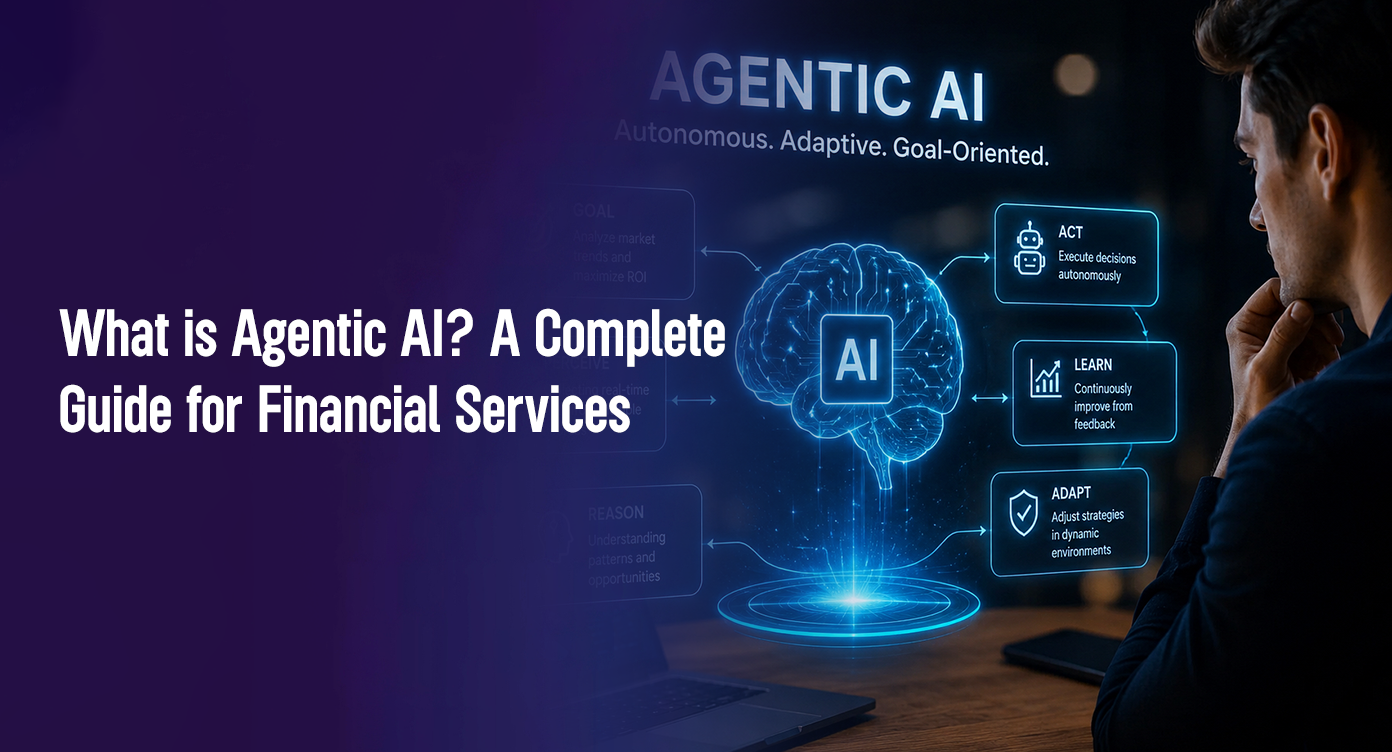
What is Agentic AI? A Complete Guide for Financial
Services
Introduction
Artificial Intelligence has already transformed many aspects
of the financial services industry, from fraud detection and customer support
to credit scoring and risk assessment. However, a new generation of AI is
emerging that goes beyond simple automation and predictive analytics. This next
evolution is known as Agentic AI.
Agentic AI represents a significant leap forward in how
financial institutions operate. Unlike traditional AI systems that require
constant human direction, Agentic AI can independently analyze situations, make
decisions, execute tasks, and adapt its actions based on outcomes. For banks,
NBFCs, lenders, insurance companies, and fintech organizations, this technology
is creating opportunities to improve efficiency, reduce costs, enhance customer
experiences, and make faster business decisions.
In this guide, we will explore what Agentic AI is, how it
works, and why it is becoming a game-changer for the financial services
industry.
What is Agentic AI?
Agentic AI refers to intelligent systems that can operate
autonomously to achieve specific goals. These AI agents can perceive
information, analyze data, make decisions, take actions, and continuously learn
from the results.
Traditional AI generally focuses on answering questions,
generating content, or making predictions. Agentic AI goes a step further by
actively executing tasks and managing workflows without requiring constant
human intervention.
For example, in a lending environment, an Agentic AI system
can:
- Collect borrower information
- Verify documents
- Assess creditworthiness
- Evaluate risk factors
- Recommend loan approval decisions
- Trigger compliance checks
- Communicate with applicants
All within a single coordinated workflow.
Agentic AI vs Traditional AI
Traditional
AI :-
Provides
recommendations, Requires
human intervention, Handles
individual tasks, Reactive
responses, Limited
adaptability
Agentic
AI:- Takes
actions based on goals, Operates
with autonomy, Manages
complete workflows, Proactive
decision-making, Continuously
learns and improves
While traditional AI serves as an assistant, Agentic AI
functions more like a digital team member capable of independently completing
complex processes.
Why Agentic AI Matters in Financial Services
Financial institutions process millions of transactions,
customer requests, compliance checks, and lending decisions every day. Managing
these operations manually often leads to inefficiencies, delays, and increased
operational costs.
Agentic AI helps solve these challenges by:
Faster Decision-Making
AI agents can process large volumes of financial data in
seconds, enabling real-time decision-making.
Reduced Operational Costs
Automation of repetitive tasks reduces dependency on manual
processes and improves productivity.
Improved Customer Experience
Customers receive faster responses, quicker approvals, and
more personalized interactions.
Enhanced Risk Management
AI agents continuously monitor risk indicators and identify
potential issues before they escalate.
Better Compliance
Automated compliance monitoring helps financial institutions
stay aligned with regulatory requirements.
Key Applications of Agentic AI in Fintech
1. Loan Underwriting and Credit Assessment
Traditional underwriting often involves manual document
reviews and lengthy approval cycles.
Agentic AI can:
- Analyze borrower profiles
- Verify income and identity
- Assess repayment capacity
- Detect anomalies
- Generate approval recommendations
This significantly reduces loan processing time while
improving accuracy.
2. Fraud Detection and Prevention
Fraud remains one of the biggest challenges in financial
services.
Agentic
AI continuously monitors transactions and customer behavior patterns to
identify suspicious activities in real time.
Benefits include:
- Faster fraud detection
- Reduced financial losses
- Improved security
- Better customer trust
3. Customer Support Automation
Modern customers expect instant support.
Agentic AI-powered virtual assistants can:
- Resolve common queries
- Assist with account management
- Guide customers through applications
- Escalate complex issues when necessary
This creates a seamless customer experience while reducing
support costs.
4. Collections and Recovery Management
Collections teams often struggle with large volumes of
overdue accounts.
Agentic AI can:
- Predict delinquency risks
- Personalize payment reminders
- Recommend collection strategies
- Automate follow-ups
This improves recovery rates while maintaining positive
customer relationships.
5. KYC and Compliance Automation
Know Your Customer (KYC) processes can be time-consuming and
resource-intensive.
Agentic AI helps automate:
- Identity verification
- Document validation
- Risk screening
- Compliance reporting
This accelerates onboarding and reduces compliance burdens.
How Agentic AI Works
Agentic AI operates through four key stages:
Observe
The AI agent gathers information from various sources such
as customer data, transactions, documents, and external databases.
Analyze
The system evaluates the collected information using
advanced machine learning models and business rules.
Decide
Based on predefined goals and risk parameters, the AI agent
determines the best course of action.
Act
The agent executes the selected action, whether it is
approving a loan, flagging a transaction, initiating customer communication, or
updating records.
This continuous cycle allows the system to improve
performance over time.
Benefits of Agentic AI in Fintech
Organizations implementing Agentic AI can experience:
Increased Efficiency
Automated workflows eliminate bottlenecks and accelerate
business operations.
Improved Accuracy
AI-driven analysis reduces human errors in decision-making.
Scalability
Financial institutions can handle higher transaction volumes
without proportional increases in staffing.
Enhanced Customer Satisfaction
-Faster services and personalized experiences lead to
stronger customer relationships.
Better Business Outcomes
Improved operational efficiency contributes to higher
profitability and competitive advantage.
Challenges and Considerations
While Agentic AI offers significant benefits, successful
implementation requires careful planning.
Key considerations include:
- Data quality and governance
- Regulatory compliance
- Transparency and explainability
- Human oversight
- Security and privacy protection
Financial institutions should adopt a balanced approach that
combines AI autonomy with appropriate human supervision.
The Future of Agentic AI in Financial Services
The future of financial services is becoming increasingly
autonomous. Agentic AI is expected to transform how organizations manage
lending, payments, collections, compliance, fraud prevention, and customer
engagement.
As AI technologies continue to evolve, financial
institutions that embrace Agentic AI will be better positioned to deliver
faster services, improve operational efficiency, and gain a competitive edge in
a rapidly changing market.
Conclusion
Agentic AI represents the next major evolution in fintech
innovation. Unlike traditional automation tools, it can independently analyze,
decide, and act to achieve business objectives.
For financial institutions seeking to improve efficiency,
reduce costs, enhance customer experiences, and strengthen risk management,
Agentic AI offers a powerful path forward.
As the financial industry moves toward intelligent
automation, organizations that invest in Agentic AI today will be well-prepared
for the future of autonomous finance.
About Credworks Fintech
Credworks Fintech is committed to helping financial
institutions leverage next-generation technologies to streamline operations,
improve decision-making, and deliver exceptional customer experiences. By
integrating Agentic AI into lending, risk management, collections, and
compliance processes, organizations can unlock new levels of efficiency and
growth.